A mural rooted in place is not illustration.
It is not a visual summary of a culture.
It begins earlier — in listening.
Before drawing, before pigment testing, before scale calculations, there is a period of immersion. Conversations with the commissioner. Observing how the space breathes. Understanding what the place carries — historically, emotionally, architecturally.
Cultural memory is not a symbol you paste onto a wall.
It is something that putting youself into the space, people, and time.
Beyond Representation: Working With Cultural Memory
When working across cultures, the challenge is restraint.
It is easy to borrow recognizable icons. It is harder to translate atmosphere.
For me, cultural memory is not about accuracy. It is about resonance — the emotional structure beneath imagery. The way a place remembers itself.
A contemporary mural rooted in culture must remain alive. It should feel as though it grew from the site, not imported into it.
Three projects illustrate how this process unfolds.
Mystery of Hope
Suttan Sofrasi, Greenwich – 9m x 2.5m Interior Mural
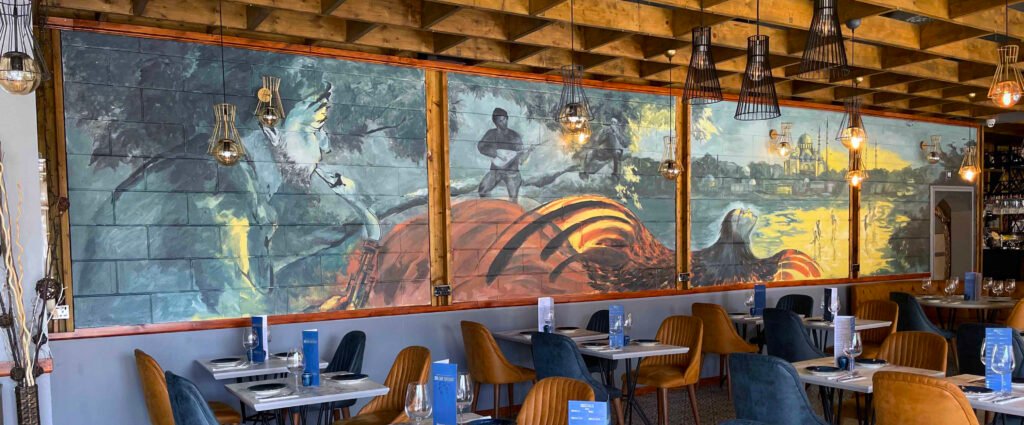
At Suttan Sofrasi, a Turkish restaurant in Greenwich, the mural developed during the aftermath of the devastating 2023 earthquake in Turkey.
The project became more than decorative. It carried weight.
Rather than depicting direct historical references, I searched for a living bridge, something that could connect East and West without becoming symbolic propaganda.
The phoenix emerged naturally. Not as mythology, but as transition.
The landscape references the Blue Mosque of Istanbul, yet it is rendered as a liminal space — a time of transition, surreal. The moment dissolves into atmosphere. The phoenix inhabits this threshold between ruin and renewal.
The mural’s title, Mystery of Hope, reflects that ambiguity. Hope is rarely loud. It is often quiet, fragile, transitional.
The wall does not illustrate Turkey.
It holds a moment of becoming.
Transparent Mumbai
Mumbaikar Vadapav, Kenton, 10.5m x 6.5 m Space Murals for an Indian Street Food Restaurant
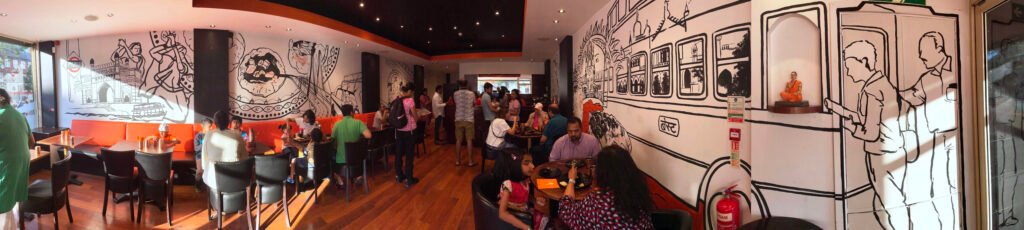
In this project, I approached cultural memory through rhythm and transparency.
Mumbai is density. Motion. Contradiction.
Using predominantly black gestural strokes, I depicted elements such as the double-decker bus, Victoria Palace, the celebration of Ganesh, street food — but rendered them semi-transparent, overlapping, permeable.
Rather than composing a narrative scene, I constructed layers of memory.
Figures dissolve into one another. Architecture does not anchor the composition… it floats within it. The mural resists solidity, much like the city itself.
Transparency becomes metaphor. A way of acknowledging that culture is not static — it is layered, constantly reconfigured through daily life.
The chaos is present, but so is beauty.
Folklore
Seoul Sarang, Ashford, 3m x 2m Mural Inspired by East Asian Ink Tradition
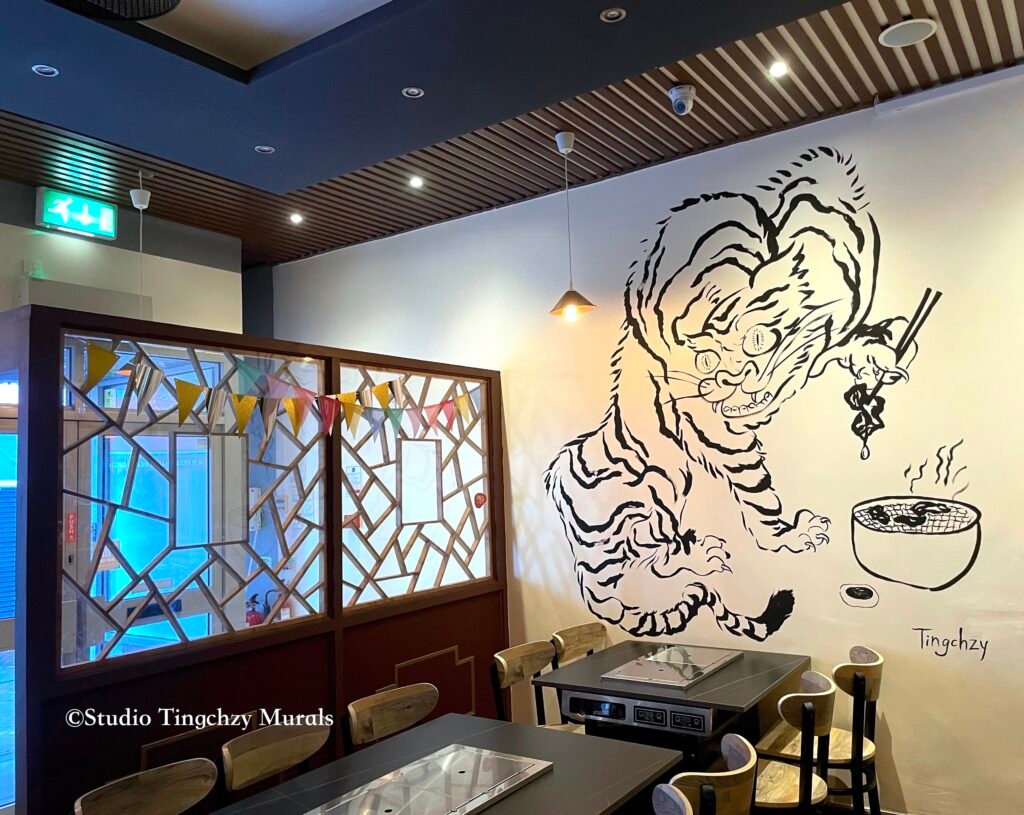
In Folklore, the tiger becomes the central presence.
Across Korea, China, Japan, and Taiwan, the tiger carries spiritual weight. It is guardian, trickster, protector, force of nature.
Instead of literal historical recreation, I translated the subject through ink painting language — large brush movement, controlled negative space, breath within gesture.
The mural maintains the sensitivity of East Asian ink tradition while existing at architectural scale.
The tiger occupies the wall with quiet intensity.
Working across cultures, I find continuity in gesture. Brush movement carries memory beyond geography.
Culture Without Illustration
Cultural translation requires empathy. It is not about imposing interpretation. In cities like London, this exchange becomes especially layered. Multiple histories coexist within a few streets. Restaurants become cultural anchors. Interiors become intimate territories of memory.
The mural, in this context, becomes spatial conversation.
Working with cultural memory does not mean recreating folklore scenes or heritage motifs.
It means translating:
- Atmosphere rather than ornament
- Gesture rather than literal storytelling
- Emotional resonance rather than surface accuracy
When successful, it does not announce its cultural references loudly. Instead, it allows viewers to sense familiarity, even if they cannot immediately identify why.
That subtlety creates longevity.
To translate cultural memory into contemporary mural is to travel without getting a flight ticket.
The work is never about spectacle. It is about continuity.
When architecture, memory, and gesture align, the wall stops being a boundary.
It becomes a living surface.
To see how these ideas unfold in completed spaces, view my mural portfolio here.
If this article resonates with your space, you are welcome to reach out directly.